
Every year, seafood processing generates large amounts of waste. In shrimp production, only about 40% of the biomass is edible, leaving millions of tons of shells as by-products. Yet these shells contain valuable compounds such as chitin, which can be converted into chitosan, a biopolymer widely used in food packaging industries, biomedical materials, and environmental applications.
However, producing chitosan efficiently can be challenging because conventional extraction involves several time- and energy-intensive steps, including drying, milling, and chemical treatments. Our recent study explored how pretreating shrimp shells before extraction, combined with ultrasound-assisted processing, could improve both efficiency and product quality.
Why pretreatment matters
Shrimp shells contain minerals such as calcium carbonate as well as proteins and residual meat attached to the shell matrix. These components can slow down drying and complicate chitin extraction.
To address this, two pretreatment strategies were individually tested on fresh shrimp shells:
- Acetic acid soaking – helping dissolve minerals and loosen the shell structure
- Pepsin-assisted enzymatic pretreatment – helping break down residual proteins and attached meat
These treatments helped remove impurities and partially dissolve minerals, making the shell structure easier to process in later steps.
Faster drying and lower energy consumption
Pretreatment had a clear impact on the drying stage. shrimp shells without pre-treatment required about 22 hours to dry, while pretreatment reduced drying time to 20 hours with acetic acid and 15 hours with pepsin.
Because the shell matrix became less compact after pretreatment, water evaporated more easily. As a result, the energy required for drying decreased from 0.498 kWh to 0.392 – 0.331 kWh per 100 g of shells on pretreatment.
The treated shells were also more fragile, making them easier to mill and reducing mechanical energy requirements during milling.
Enhancing chitosan extraction with ultrasound
After pretreatment and drying, chitosan was extracted through demineralization, deproteinization, and deacetylation steps. Ultrasound technology was applied during the first two steps to enhance extraction efficiency as illustrated below.
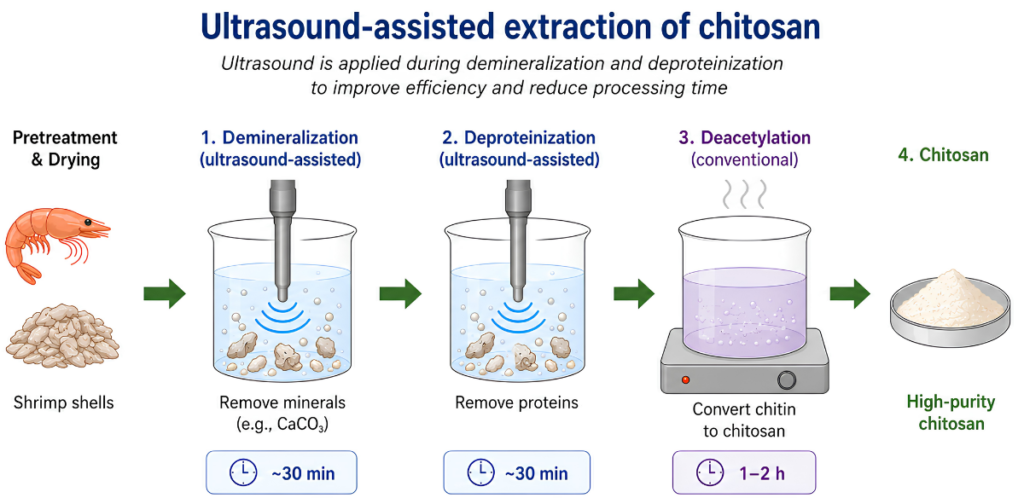
Ultrasound generates microscopic cavitation bubbles that collapse rapidly, helping break down biological structures and improving mass transfer. Using ultrasound reduced the duration of key extraction steps to around 30 minutes, significantly faster than many conventional approaches.
Producing high-purity chitosan
Pretreatment also improved the final product quality. Chitosan produced from pretreated shells showed very high purity (up to ~99.9%), along with desirable properties such as high degree of deacetylation (~95–96%), good solubility, and strong thermal stability.
Together, pretreatment and ultrasound-assisted extraction offer a more efficient way to convert shrimp shell waste into valuable biomaterials. This approach supports the circular bioeconomy, where seafood processing by-products are transformed into useful products rather than discarded.