
Par Joncer Naibaho
Chaque année, la transformation des produits de la mer génère d'importantes quantités de déchets. Dans la production de crevettes, seule une partie de la biomasse, soit environ 40%, est comestible, ce qui laisse des millions de tonnes de carapaces comme sous-produits. Or, ces carapaces contiennent des composés précieux tels que la chitine, qui peut être transformée en chitosane, un biopolymère largement utilisé dans les industries de l'emballage alimentaire, les matériaux biomédicaux et les applications environnementales.
Cependant, la production de chitosane de manière efficace peut être difficile car l'extraction conventionnelle implique plusieurs étapes chronophages et énergivores, notamment le séchage, le broyage et les traitements chimiques. Notre récente étude a exploré comment le prétraitement des carapaces de crevettes avant l'extraction, associé à un traitement assisté par ultrasons, pourrait améliorer à la fois l'efficacité et la qualité du produit.
Pourquoi le prétraitement est important
Les carapaces de crevettes contiennent des minéraux tels que le carbonate de calcium ainsi que des protéines et de la chair résiduelle attachée à la matrice de la carapace. Ces composants peuvent ralentir le séchage et compliquer l'extraction de la chitine.
Pour y remédier, deux stratégies de prétraitement ont été testées individuellement sur des carapaces de crevettes fraîches :
- Bain d'acide acétique – aide à dissoudre les minéraux et à ramollir la structure de la coquille
- Prétraitement enzymatique assisté par la pepsine – aide à décomposer les protéines résiduelles et la viande attachée
Ces traitements ont permis d'éliminer les impuretés et de dissoudre partiellement les minéraux, rendant la structure de la coquille plus facile à travailler dans les étapes ultérieures.
Séchage plus rapide et consommation d'énergie réduite
Le prétraitement a eu un impact clair sur l'étape de séchage. Les carapaces de crevettes sans prétraitement ont nécessité environ 22 heures pour sécher, tandis que le prétraitement a réduit le temps de séchage à 20 heures avec de l'acide acétique et 15 heures avec de la pepsine.
Étant donné que la matrice de coque est devenue moins compacte après le prétraitement, l'eau s'est évaporée plus facilement. En conséquence, l'énergie nécessaire au séchage a diminué de 0,498 kWh à 0,392 – 0,331 kWh pour 100 g de coques après prétraitement.
Les coquilles traitées étaient également plus fragiles, ce qui les rendait plus faciles à broyer et réduisait les besoins en énergie mécanique pendant le broyage.
Amélioration de l'extraction du chitosane par ultrasons
Après prétraitement et séchage, le chitosane a été extrait par déminéralisation, déprotéinisation et désacétylation. La technologie à ultrasons a été appliquée pendant les deux premières étapes pour améliorer l'efficacité de l'extraction, comme illustré ci-dessous.
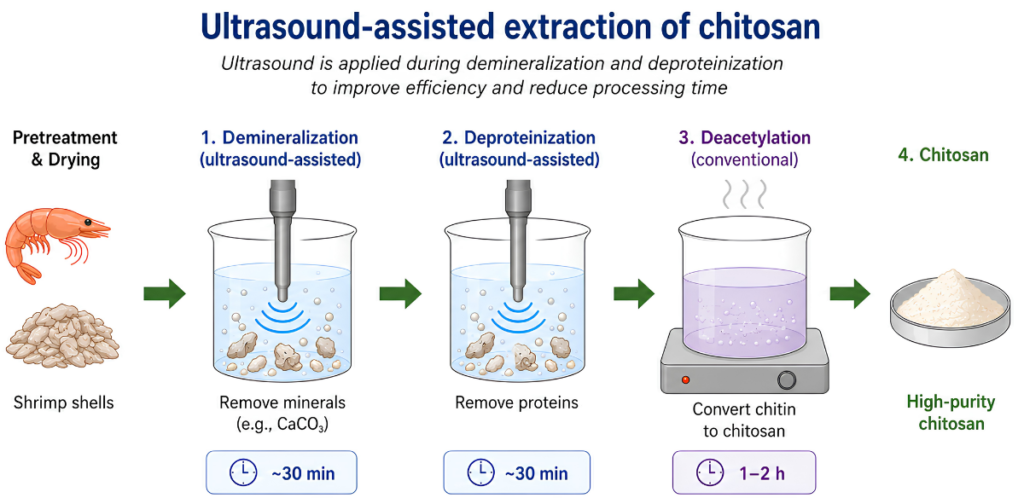
Les ultrasons génèrent des bulles de cavitation microscopiques qui implosent rapidement, aidant à décomposer les structures biologiques et améliorant le transfert de masse. L'utilisation des ultrasons a réduit la durée des étapes d'extraction clés à environ 30 minutes, ce qui est considérablement plus rapide que de nombreuses approches conventionnelles.
Production de chitosane de haute pureté
Le prétraitement a également permis d'améliorer la qualité du produit final. Le chitosane obtenu à partir des coquilles prétraitées présentait une très grande pureté (jusqu'à environ 99,91 TP3T), ainsi que des propriétés intéressantes telles qu'un degré élevé de désacétylation (environ 95–961 TP3T), une bonne solubilité et une grande stabilité thermique.
Ensemble, le prétraitement et l'extraction assistée par ultrasons offrent un moyen plus efficace de convertir les déchets de carapace de crevettes en biomatériaux de valeur. Cette approche soutient la bioéconomie circulaire, où les sous-produits de la transformation des produits de la mer sont transformés en produits utiles plutôt que d'être rejetés.