Ever wondered what is hidden and left behind the fish filleting process? IMPRESS team in Teagasc is exploring the enormous wealth from the ocean’s depths endowed with overlooked and untapped value.
Why fish by-products matter?
The processing industrial sector currently releases a fish waste quantity accounting for 20-50% of the overall fish weight. Ireland produces approximately 10,000-12,000 tonnes of whitefish waste and 3,000 tonnes of salmon waste annually. This generates significant ecological and economic issues, including water contamination, undesired odours, public health risks, and high treatment and disposal costs to meet the strict environmental regulations currently in place.
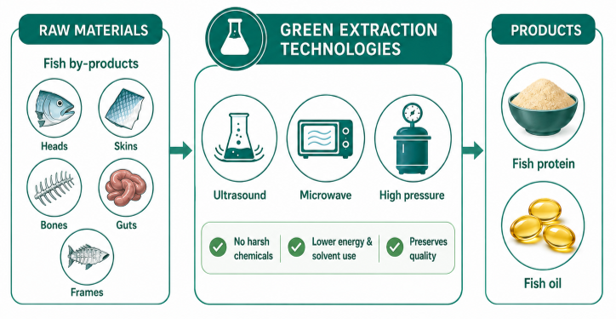
In the present scenario, these enormous amounts of fish by-products, such as heads, skins, and bones, have the great potential to be turned into valuable bioactive compounds such as proteins and oil that can be utilised mainly in the food and feed sectors, addressing both environmental concerns and nutritional needs. Fish proteins are endowed with high digestibility, fat-blocking properties, and beneficial effects against diabetes. Moreover, the unique composition of polyunsaturated fatty acids in fish oil, is reported to be helpful against serious disorders like diabetes, asthma, cardiovascular and psychiatric diseases, and cancer.
Greener extraction technologies
Innovative, eco-friendly methods including ultrasound, microwave, and high-pressure processing can extract these nutrients without heat or chemicals, preserving their properties. This approach not only reduces pollution and disposal costs but also produces high-quality ingredients such as beneficial oils and easily digestible proteins, supporting sustainable practices and healthier fish-based diets.
Ultrasound and microwave extraction uses the energy generated by ultrasound and microwave radiations, respectively, to break the material cells and release the contained bioactive compounds into the solvent employed for the process. Similarly, in high-pressure processing, cells rupture and consequent recovery of components of interest are achieved by applying intense pressure, 6000 times higher than the normal atmospheric pressure.
Promising results from Teagasc research
Teagasc researchers have successfully applied these advanced technologies to recover proteins and oils from fish by-products such as heads, skins, guts, and frames.
Haddock fish by-products were subjected to high-pressure processing pre-treatment followed by ultrasound extraction. This advanced method provided more than 30% amount of extracted protein, or protein recovery yield, thrice the quantity obtained by conventional extraction. With respect to the latter, the digestibility of the proteins extracted by ultrasound and high-pressure processing resulted to be significantly higher, indicating their improved nutritional value and suitability for human absorption.
In another study, salmon fish filleting by-products were employed to obtain fish oil by applying microwave and ultrasound treatments. Microwave alone and microwave combined with ultrasound for 10 minutes gave an oil recovery yield accounting for almost 60%, comparable to 30 min conventional fish high temperature heating in water. Notably, the fatty acids profile of the generated oil remained nutritionally favourable across all the treatments, with a strong prevalence of unsaturated fatty acids, linked to beneficial health effects.
Supporting a circular seafood economy
The developed technologies are efficient, fast, and versatile, representing eco-friendly options due to reduced energy consumption and heat production, ensuring safety and quality preservation. These techniques reduce solvent consumption and eliminated the need of harsh chemicals, and the above-mentioned research work only involved water or water-based solvents. This contributes to the development of green processes and clean ingredients. These routes support the effective and sustainable exploitation of marine resources to enrich market for aquatic ingredients as food supplements and nutraceuticals, in line with the principles of circular economy and sustainable aquatic resources management.
Innovative research at Teagasc is transforming these by-products into healthy fish protein and oil, contributing to IMPRESS’s goal to offer eco-responsible solutions for the marine industry side streams.